CONGO PROJECT LOGISTICS
On-the-Ground Logistics for the DRC Mining Sector
Local infrastructure.
Regional connections.
Global supply-chain reach.

Congo Project Logistics provides Nucleus with an established operational presence within the Democratic Republic of Congo, creating a direct link between international supply chains and some of Central Africa's most important mining regions.
Rather than managing the DRC remotely, CPL provides local infrastructure and operational capability supporting cargo receiving, warehousing, handling and distribution within the country.
The current Nucleus website describes CPL as providing a "frontline approach" to the DRC market and enabling a single-window operation for cargo moving from international origins into the DRC.
SCOPE OF SERVICE
-
DRC logistics coordination
-
Warehousing and secure storage
-
Cargo receiving
-
Central receiving operations
-
Cross-docking
-
Cargo handling
-
Inventory and warehouse management
-
Cargo consolidation
-
Local distribution
-
Mine-site delivery
-
Cross-border transport coordination
-
Zambia–DRC corridor support
-
Customs and documentation coordination
-
Project cargo handling
-
Mining supply-chain support
-
Cargo staging
-
Parking and operational support
-
Integration with international road, ocean and airfreight movements

Strategic DRC Locations
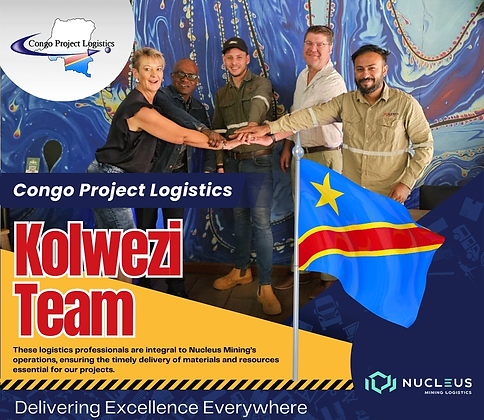
The DRC operation includes facilities and capability in Lubumbashi, Kolwezi and Kamoa.
Lubumbashi
2,500 m² under-roof warehousing
3,200 m² outside area
Lubumbashi provides a strategically positioned logistics and distribution base serving the wider Copperbelt.
Kolwezi
1,000 m² warehousing
Bonded-facility capability
Kamoa
1,300 m² central receiving facility
ARSP-compliant operations
Local distribution capability
±3000m² Mine site warehouses
Connecting the DRC to the Nucleus Mining Logistics Network
Congo Project Logistics works as part of the wider Nucleus Mining Logistics network rather than as an isolated DRC operation.
Cargo can be routed through South Africa, Zambia, Namibia and other regional gateways, providing clients with alternative corridor options based on origin, destination, cargo requirements and operational risk.
This is particularly valuable for mining operations where supply-chain reliability depends on what happens before the cargo ever reaches the DRC border.